
Guides
Toronto compared with Vancouver on platform creator taxes and payouts
Creator economy Canada: compare Toronto and Vancouver on GST/HST thresholds, platform payout reporting, 1099-equivalent forms, provincial tax rates and CRA filing.
What to take away
- In the creator economy Canada, GST/HST registration is federal and applies equally in Toronto and Vancouver once you exceed the small supplier threshold.
- Platform payout reporting in Canada relies on T4A and T5 slips, not US 1099 forms. YouTube, TikTok and Meta pay through foreign entities and issue no T4A.
- Ontario creators charge 13% HST; BC creators charge 5% GST plus 7% PST, so Vancouver ad pricing differs.
- Toronto creators face Ontario marginal rates up to 53.53%; Vancouver creators face BC rates up to 53.50%.
- Both cities file GST/HST returns with the CRA on the same deadlines, but BC also has a separate PST return.
GST/HST registration thresholds for creators in Toronto and Vancouver
The GST/HST registration threshold is federal, so it applies the same way in Toronto and Vancouver. You must register once your taxable supplies exceed $30,000 over four consecutive calendar quarters. That includes ad revenue, sponsorships, affiliate income and digital product sales.
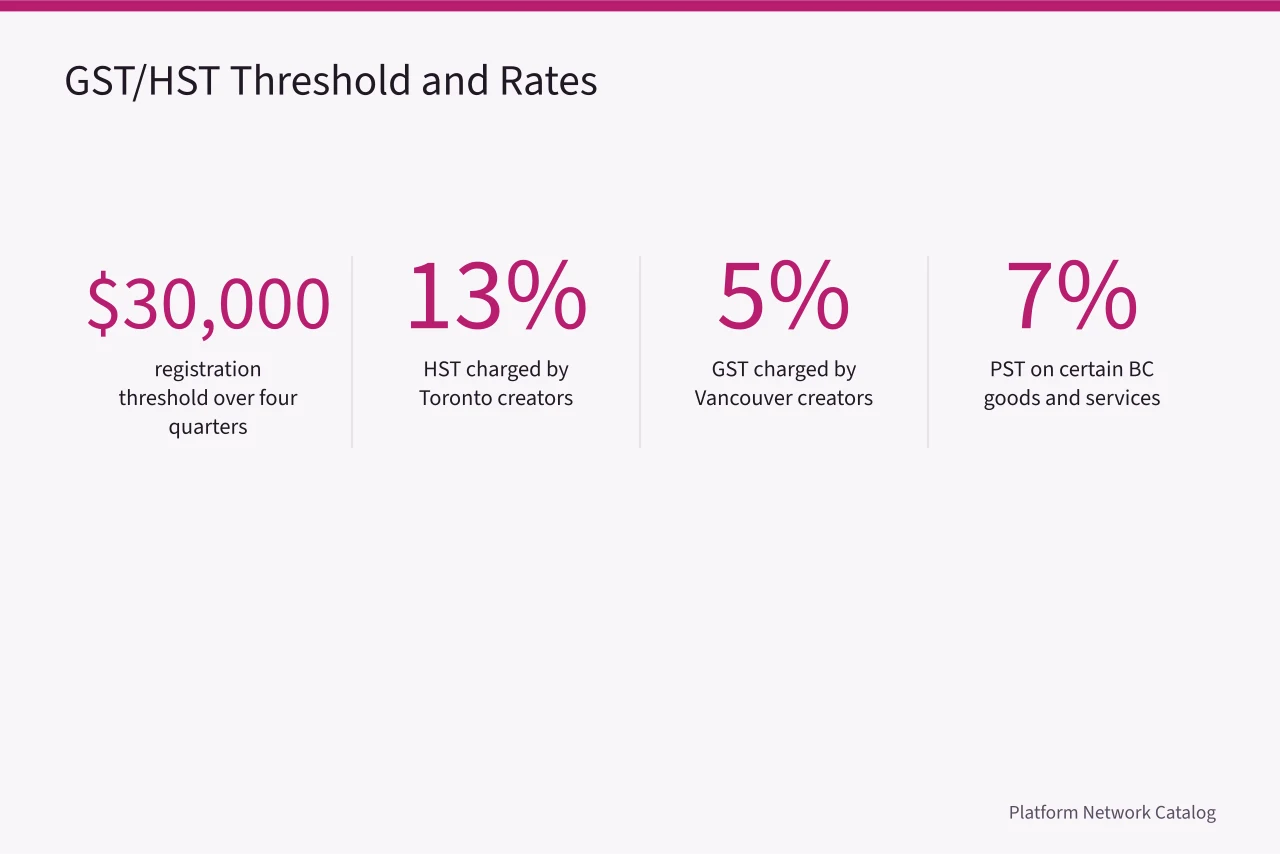
If you are a small supplier, you can stay unregistered. But once you cross the threshold, you must register within 29 days of the end of the quarter in which you exceed it. The Canada Revenue Agency (CRA) administers this rule across all provinces.
You can register voluntarily even below the threshold. That lets you claim input tax credits on business expenses like cameras, software and home office costs. Many full-time creators register early for that reason.
Keep in mind that the threshold counts gross revenue, not profit. If you earn $31,000 in ad revenue but spend $10,000 on production, you still cross the threshold. Track your income quarterly to avoid a surprise.
The CRA taxes portal is the starting point for registration and filing. It covers GST/HST, payroll and corporate income tax. Taxes - Canada.ca links to all the CRA services a creator needs.
For a broader view of what business taxes apply to your platform work, see the Business taxes - Canada.ca page. It explains how GST/HST, payroll and income tax fit together for self-employed creators.
Platform payout reporting and 1099-equivalent forms in Canada
Canada does not use 1099 forms. The 1099 equivalent Canada creators receive is usually a T4A slip for fees for services, or a T5 for investment income. A payer with a Canadian entity must issue a T4A when it pays you more than $500 for services in a year.
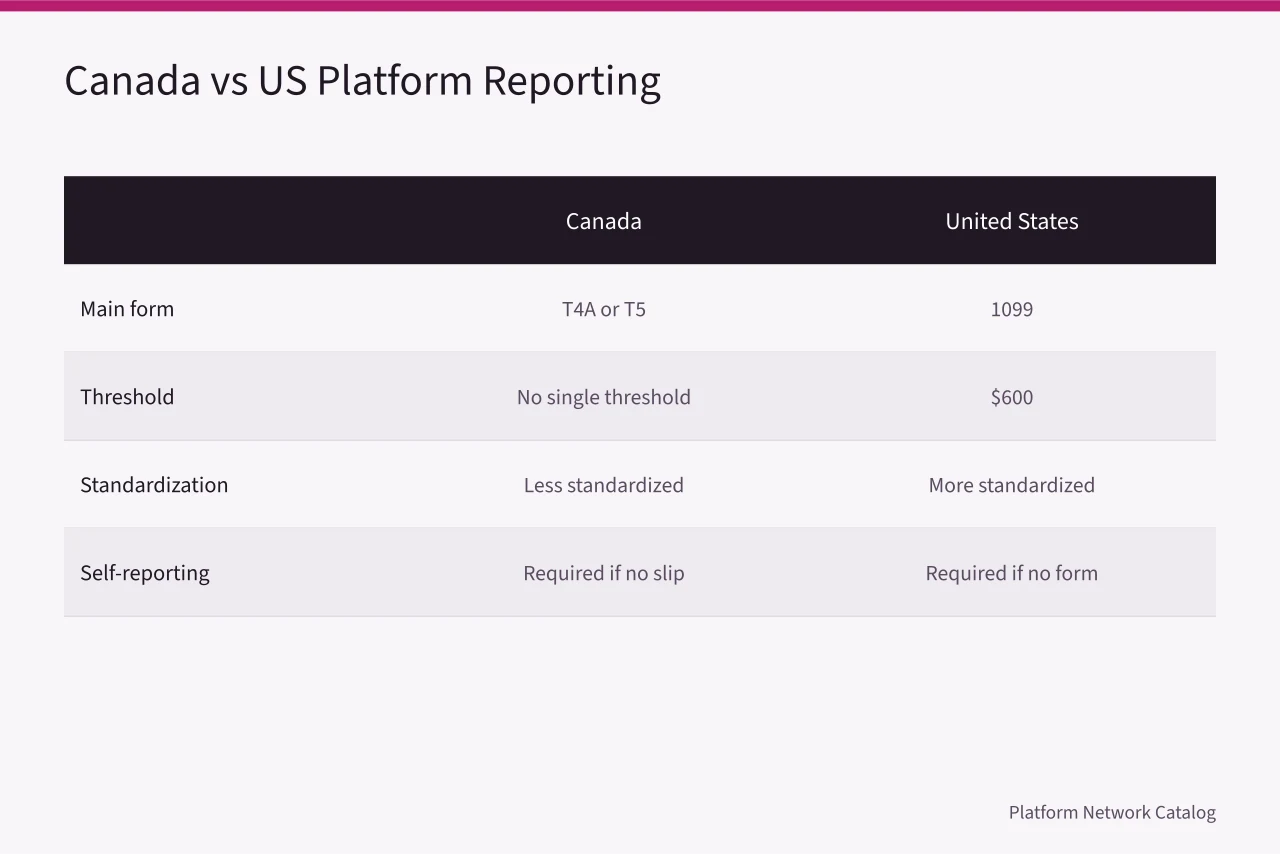
YouTube, TikTok and Meta generally pay Canadian creators through non-Canadian entities, so they issue no T4A for ad revenue share and you report that income yourself. A T4A reaches you from a Canadian payer: a brand, agency, broadcaster or network that contracts you directly.
CRA rules set no minimum for reporting income. The $500 figure is a slip threshold, not a tax threshold. Whether or not a slip arrives, you report all platform income.
If you receive a T4A, check that the amount matches your records. Platforms sometimes report gross earnings before fees, while you receive net. The CRA wants the gross amount, and you deduct fees as expenses.
For creators in Toronto and Vancouver, the reporting obligation is the same. The difference is which platform entity pays you. A US-based platform may not issue a Canadian slip, so you need to track earnings yourself.
Keep a spreadsheet of monthly payouts from each platform. Note the date, amount, currency and any fees withheld. If the platform pays in USD, convert to CAD using the Bank of Canada exchange rate on the payment date.
If you run giveaways or paid promotions, those payments are also taxable. A Social Media Giveaway in Canada has its own budget and tax treatment, so keep those receipts separate.
Provincial tax treatment for creators in Ontario and British Columbia
Ontario and British Columbia have different sales tax systems. Ontario has a single 13% HST. British Columbia has a 5% GST plus a 7% PST, for a combined 12% on many items.
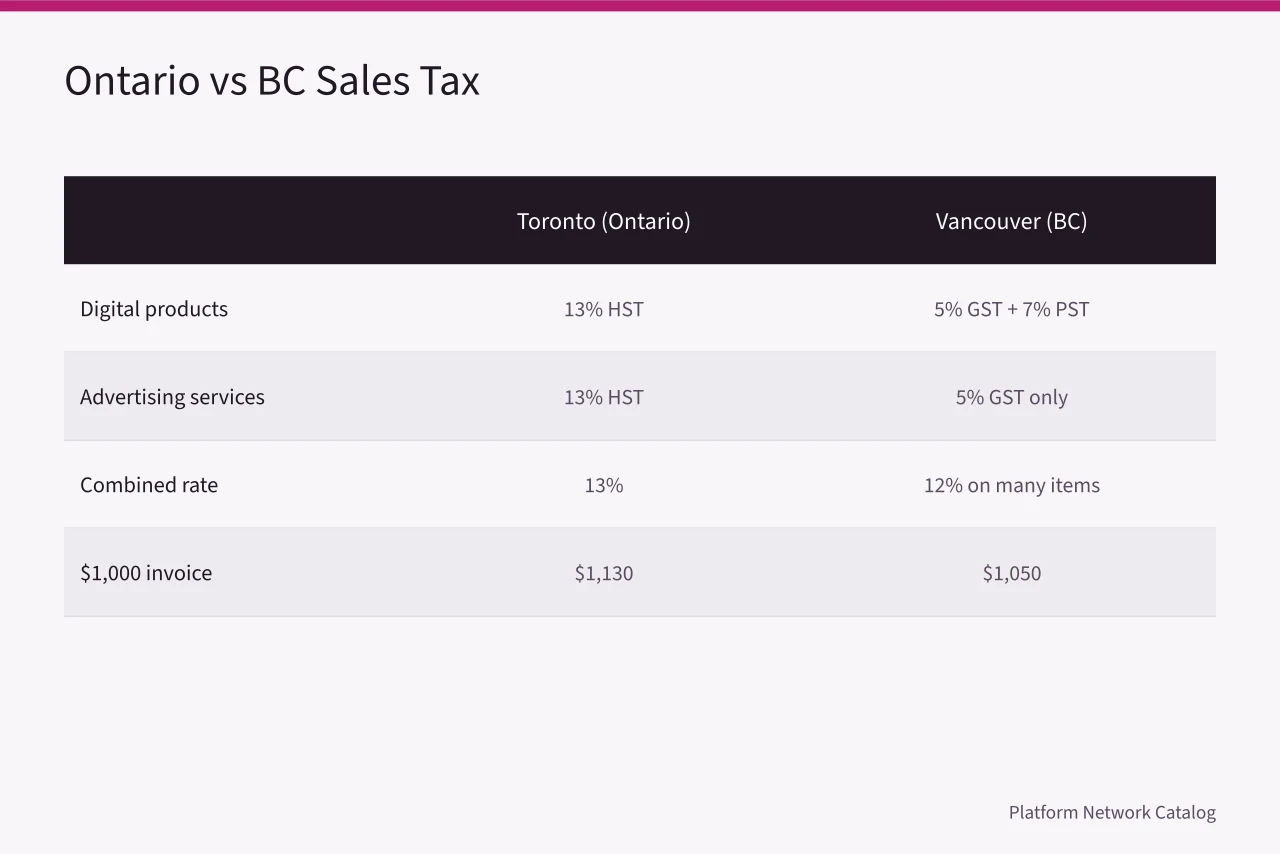
For creators, the key difference is what you charge on digital products and services. In Ontario, you charge 13% HST on most digital products. In BC, you charge 5% GST and 7% PST on digital products, but some services are PST-exempt.
In Ontario, advertising services carry 13% HST. In BC, advertising services bought for business use are exempt from PST, so a Vancouver creator invoices 5% GST on ad work and no PST.
This affects your pricing. If you quote a flat fee to a Canadian brand, you need to know whether tax is included. A $1,000 invoice in Toronto becomes $1,130 with HST. In Vancouver, it becomes $1,050 with GST.
The BC government provides a central page for provincial taxes and credits. Taxes and tax credits - Province of British Columbia explains PST, income tax and other provincial obligations for Vancouver creators.
Ontario's HST rules are set out by the province. Harmonized Sales Tax | ontario.ca covers what is taxable and how to charge HST on goods and services.
Income tax also differs. Ontario has a surtax and health premium. BC has a different bracket structure and a climate action tax credit. Ontario's top bracket starts at $220,000 and its top rate is 13.16% before surtax.
BC's top bracket starts at about $260,000 with a 20.5% top rate. Your marginal rate depends on your total income, not just your platform earnings.
CRA guidance on platform income and deductions
The CRA treats platform income as business income if you are carrying on a business. That means you report it on form T2125, Statement of Business or Professional Activities, with your personal tax return.
You can deduct reasonable expenses. Common deductions for creators include equipment, software subscriptions, internet, a portion of rent or utilities for a home office, and platform fees. Keep receipts for at least six years.
If you incorporate, the rules change. A company submits a T2 return and remits corporate tax. Many creators incorporate once income exceeds $100,000 to $150,000, but that depends on your situation.
GST/HST filing is separate from income tax. You file GST/HST returns monthly, quarterly or annually, depending on your revenue. The CRA explains the filing options and deadlines on its website.
For step-by-step filing instructions, see How to file - File your GST/HST return - Canada.ca. It covers NETFILE, My Business Account and paper filing.
The CRA also expects you to keep records of platform payouts. If you do not receive a slip, your own records are the evidence. The CRA can reassess you for up to four years after filing.
If you have a dispute with a platform over payouts, you can File a Complaint with the platform or a regulator. Keep records of all communications.
Comparing Toronto and Vancouver: tax rates and filing deadlines
Toronto and Vancouver have similar federal tax rates but different provincial rates and filing deadlines. The table below compares the key numbers for 2026.
Tax rates and filing deadlines
Toronto (Ontario)
- Provincial sales tax
- 13% HST
- Advertising services
- 13% HST
- Provincial top rate
- 13.16% plus surtax and health premium
- Top bracket starts at
- $220,000
- Combined top marginal rate
- 53.53%
- Separate provincial return
- None
- GST/HST return due
- One month after period end
- Personal tax return due
- April 30, or June 15 if self-employed
- Balance owing due
- April 30
Vancouver (BC)
- Provincial sales tax
- 5% GST plus 7% PST
- Advertising services
- 5% GST, PST exempt for business use
- Provincial top rate
- 20.5%
- Top bracket starts at
- About $260,000
- Combined top marginal rate
- 53.50%
- Separate provincial return
- BC PST return
- GST/HST return due
- One month after period end
- Personal tax return due
- April 30, or June 15 if self-employed
- Balance owing due
- April 30
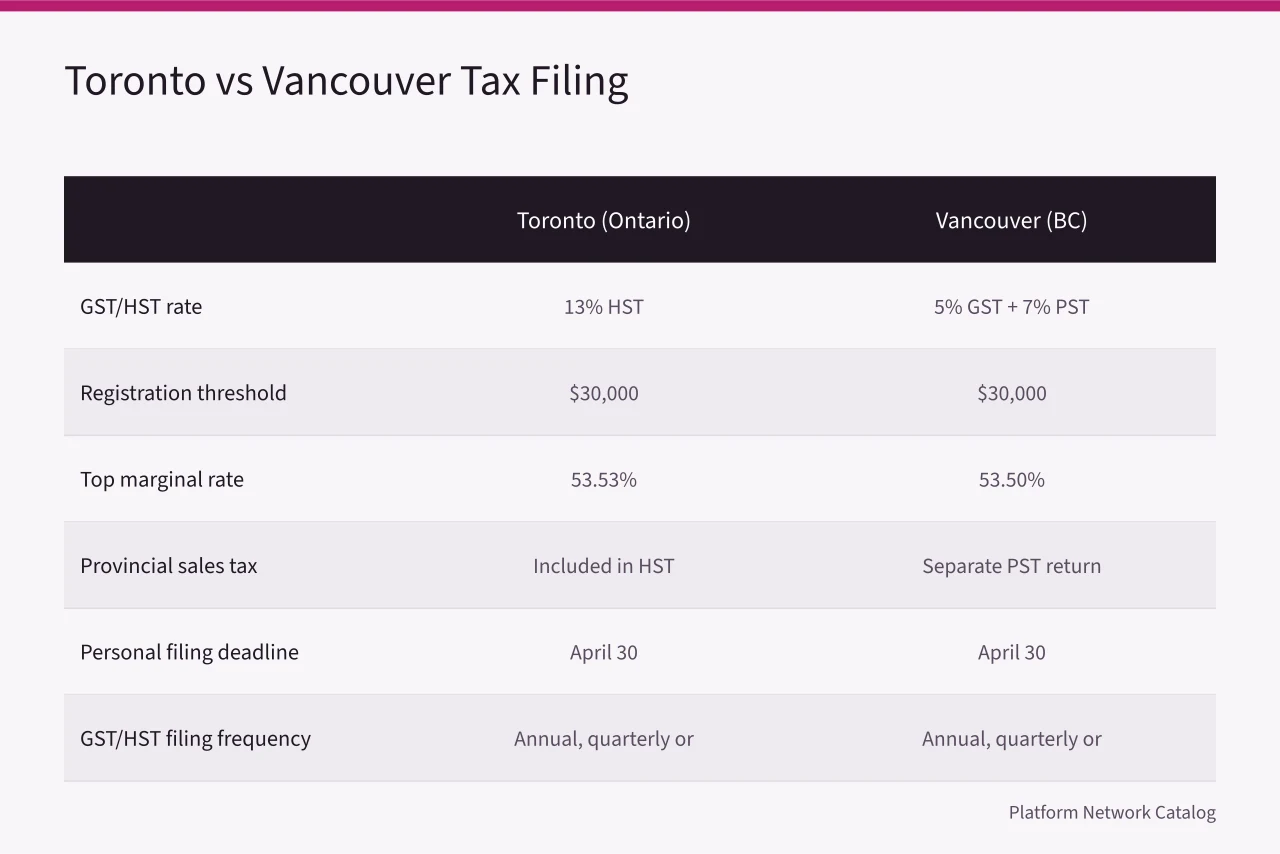
Both cities share the same federal filing deadline of April 30 for personal tax. If you or your spouse are self-employed, the deadline is June 15, but any balance owing is still due April 30.
GST/HST filing frequency depends on your revenue. Under $1.5 million, you can file annually. Between $1.5 million and $6 million, quarterly. Above $6 million, monthly. Most creators file annually or quarterly.
Monthly and quarterly returns are due one month after the end of the reporting period. Annual filers have three months after their fiscal year end, and individuals with a December 31 year end get until June 15 to file but must pay by April 30.
BC has a separate PST return. If you are registered for PST, you file separately from GST/HST. BC assigns monthly filing to registrants collecting $5,000 or more in PST over a year, and quarterly or annual below that.
PST returns and payment are due the last day of the month after the reporting period. Ontario has no separate provincial sales tax return because HST is combined.
Toronto has a higher concentration of platform offices and ad agencies, which can mean more local sponsorship opportunities. Vancouver has a growing tech and film sector, with different brand partners.
Steps to register and file as a creator
Steps to register and file
- Determine your gross revenue for the last four calendar quarters. If you exceed the threshold, you must register for GST/HST.
- Register for a CRA business number and GST/HST account through My Business Account or by mail.
- If you are in BC and sell taxable goods, register for PST with the BC government.
- Set up your bookkeeping to track income and expenses by platform and by province.
- Charge the correct tax on each invoice for your province.
- File your GST/HST return by your assigned deadline, and file your personal tax return by April 30 or June 15.
- Keep all records for six years in case the CRA reviews your platform income.
Use this checklist to stay compliant:
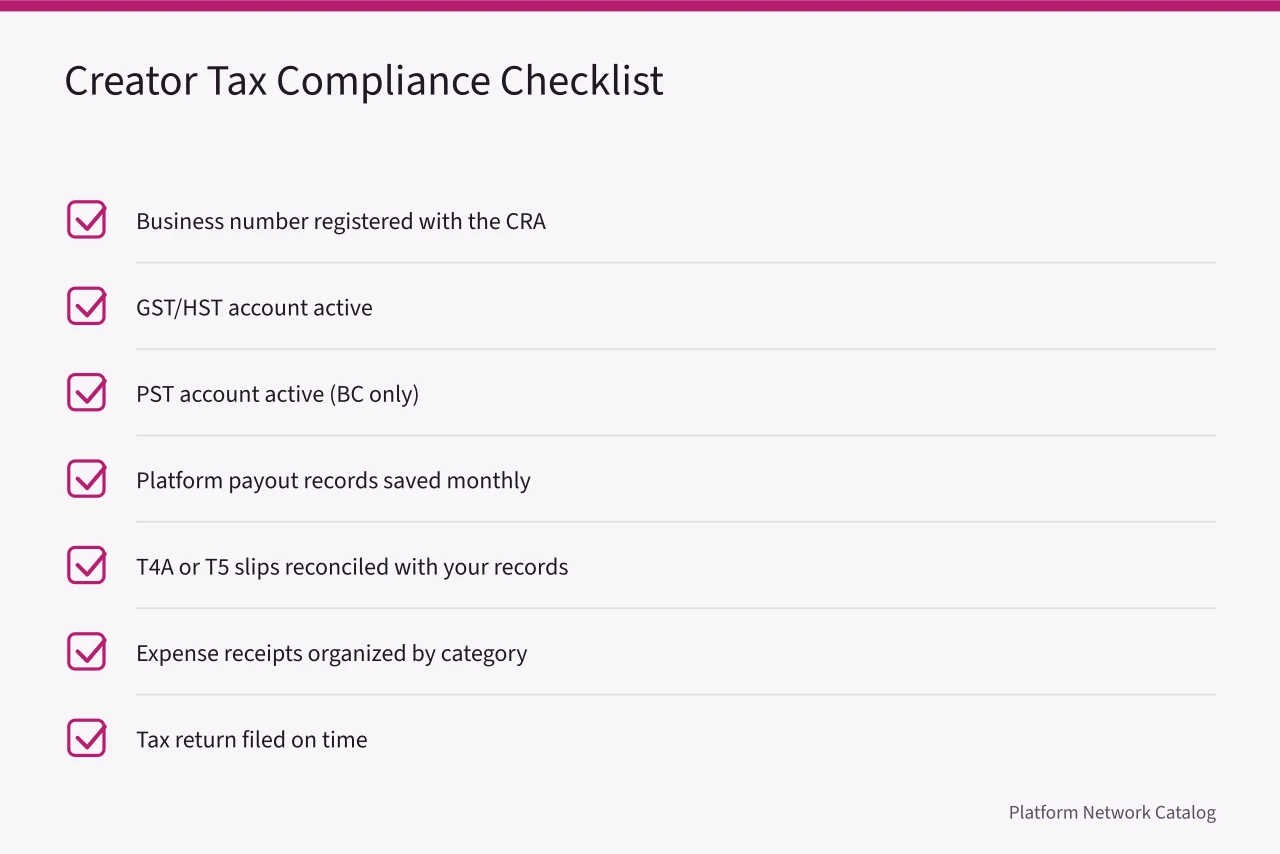
If you hire an accountant, give them your platform payout summaries and expense records. They can determine the correct tax treatment for your situation.