Costs
Podcast platform payouts: how payments work
Podcast platform payouts follow different ad, subscription, and membership rules. See what Spotify, Apple Podcasts, and YouTube disclose about payment timing.
What to take away
- YouTube is the only one of the three with a published payout floor: $100 in combined earnings, paid monthly around the 21st.
- Apple keeps 30 percent of a subscription in a subscriber's first paid year and 15 percent after, and pays on a lagged monthly cycle.
- Spotify's ad money moves through the Partner Program, and its payout minimum is set by the payout partner you connect, not by one global number.
- None of the three publishes a fixed dollars-per-listen figure, so any local earnings estimate is arithmetic you run with your own download and conversion numbers.
- Connect payout accounts and tax details before you cross a threshold, because a name mismatch stalls the transfer.
This comparison of podcast platform payouts sits inside the wider creator income economy. Spotify, Apple, and YouTube payouts shape earnings for podcasters, YouTubers, and influencers alike, not only Seattle audio creators. The platform rules below apply to any creator who runs ads, sells subscriptions, or earns memberships. Seattle is one local example of how wages, listener income, and sponsor rates change the inputs.
For readers tracking creator income, separate platform rules from local conditions. Platform rules set the commission, payout floor, and payment timing. Local conditions set downloads, conversion, and ad rates. That split lets you compare payout options across cities, niches, and audience types while keeping the same math.
The three payout doors, and why the numbers are not symmetric
Each platform pays through a different mechanism, which is why a single "payout rate" comparison does not exist.
YouTube runs an open ad revenue share inside the Partner Program. Spotify pays ad revenue only to shows admitted to its Partner Program, plus subscription money. Apple pays almost nothing for ads and everything through subscriptions.
That asymmetry decides which platform is worth your admin time. A show built on downloads should weight YouTube. A show with a paying core should weight Apple.
Spotify: Partner Program share and a partner-set minimum
Spotify does not run a flat revenue share open to every show. Ad money reaches creators through the Spotify Partner Program, which admits shows on audience size and listener geography.
Once admitted, Spotify pays a share of the ad revenue served inside your episodes. The share is set in your program terms, not in a public rate card, so the figure to model is your own ad revenue multiplied by the share stated in your agreement.
Subscriptions are the second door. A listener pays a monthly fee, Spotify takes its cut, and the remainder lands in your Spotify for Creators dashboard on the same payout calendar as ad earnings.
The minimum before money moves is not one global number. It varies by country and by the payout partner connected to your account, so the figure that applies to you is the one shown in your own dashboard. Treat Spotify as a mid-tier earner for most podcast creators: below YouTube on ad revenue, above Apple on ad-supported audio.
Apple: 30 percent, then 15 percent, on a lagged cycle
Apple Podcasts has no ad network inside the app. Subscription commission is the published number: Apple keeps 30 percent of a subscriber's payment in that subscriber's first paid year and 15 percent in each year after.
The arithmetic is direct. If a listener pays a monthly subscription price of P, Apple keeps 0.30 x P for the first twelve months and 0.15 x P from month thirteen, and the rest is yours.
Reporting runs on Apple's calendar. Subscription revenue appears in Apple Podcasts Connect and in the reports Apple sends, on a monthly cycle with a lag before funds settle. Apple does not publish one global payout minimum, so the threshold that applies is set in your account's currency and shows in Apple Podcasts Connect.
Apple is the weakest of the three for ad revenue and the strongest for listener-funded shows. A few hundred paying listeners can out-earn a much larger ad-supported show, because subscription revenue per listener is far higher than ad revenue per download.
YouTube: the $100 floor, the 21st, and the tax gate
YouTube is the most transparent of the three. The Partner Program requires you to clear its subscriber and watch-hour thresholds, and it pays only after your combined balance across ads, memberships, and other features reaches $100.
Below $100 the balance rolls over. Above it, YouTube pays monthly, usually around the 21st for the prior month's earnings.
Tax paperwork gates the money. YouTube requires tax information in AdSense before it will pay, and it issues US creators a 1099 for qualifying earnings. Non-US creators face withholding unless a treaty applies.
Content disputes can divert or freeze revenue, and the rules behind claims and counter-notices trace to the Digital Millennium Copyright Act framework. For a podcast, YouTube's real advantage is discovery: clips and full episodes surface in search in a way audio-only platforms do not match, and that reach is what makes the $100 floor reachable.
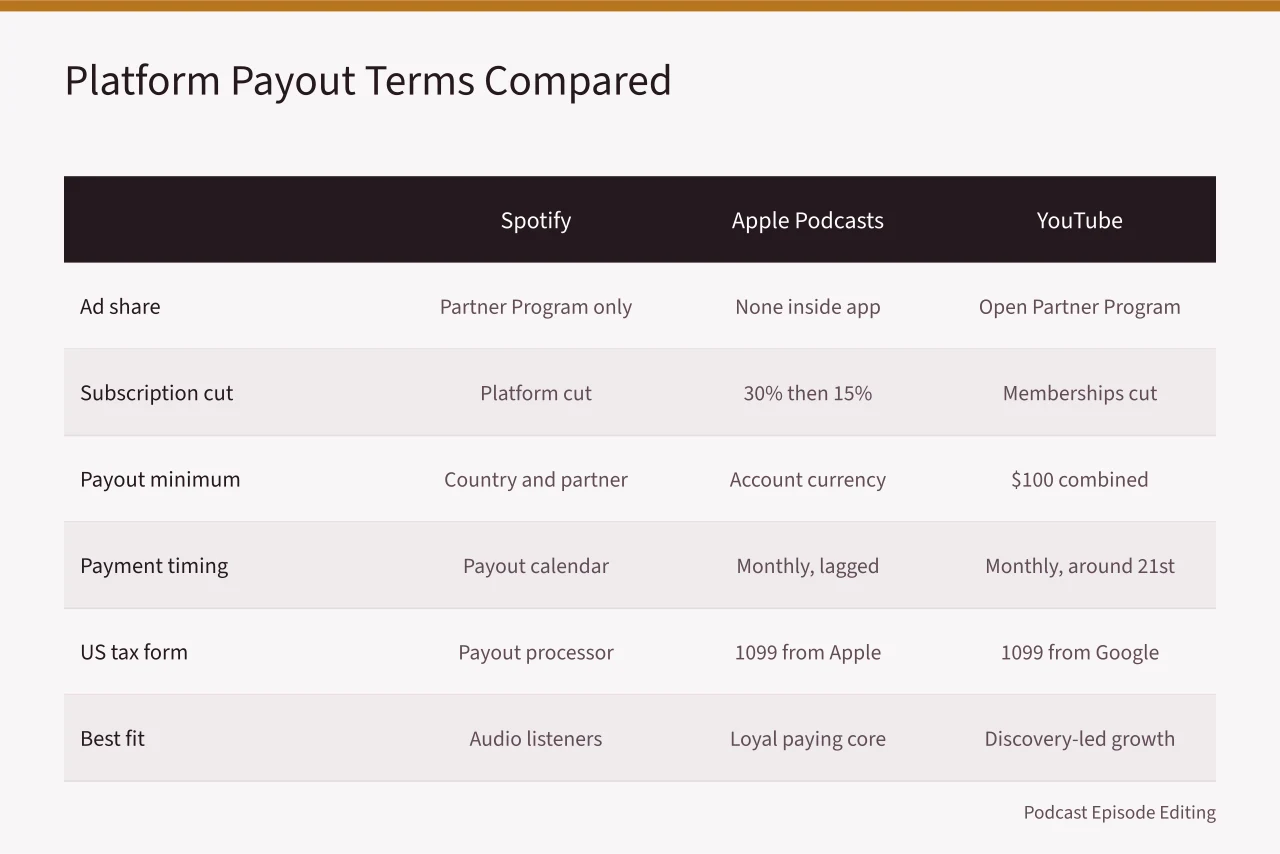
Payout floors, commission rates and tax forms
Spotify
- Ad revenue share
- Partner Program only, share set in your agreement
- Subscription commission
- Platform cut, remainder to creator
- Payout minimum
- Set by country and payout partner
- Payment timing
- Payout calendar tied to balance
- US tax form
- From the payout processor
- Best fit
- Audio listeners who will not use YouTube
Apple Podcasts
- Ad revenue share
- None inside the app
- Subscription commission
- 30% first paid year, 15% after
- Payout minimum
- Set in your account currency
- Payment timing
- Monthly reports, lagged settlement
- US tax form
- 1099 from Apple for qualifying earnings
- Best fit
- A loyal paying core
YouTube
- Ad revenue share
- Open share inside the Partner Program
- Subscription commission
- Memberships, platform cut
- Payout minimum
- $100 combined balance
- Payment timing
- Monthly, around the 21st
- US tax form
- 1099 from Google for qualifying earnings
- Best fit
- Discovery-led growth
The honest summary of this table: only YouTube publishes a dollar floor, only Apple publishes a commission rate, and Spotify publishes neither.
Building a payout estimate from your own numbers
Build the estimate from your own numbers: name the variables and substitute.
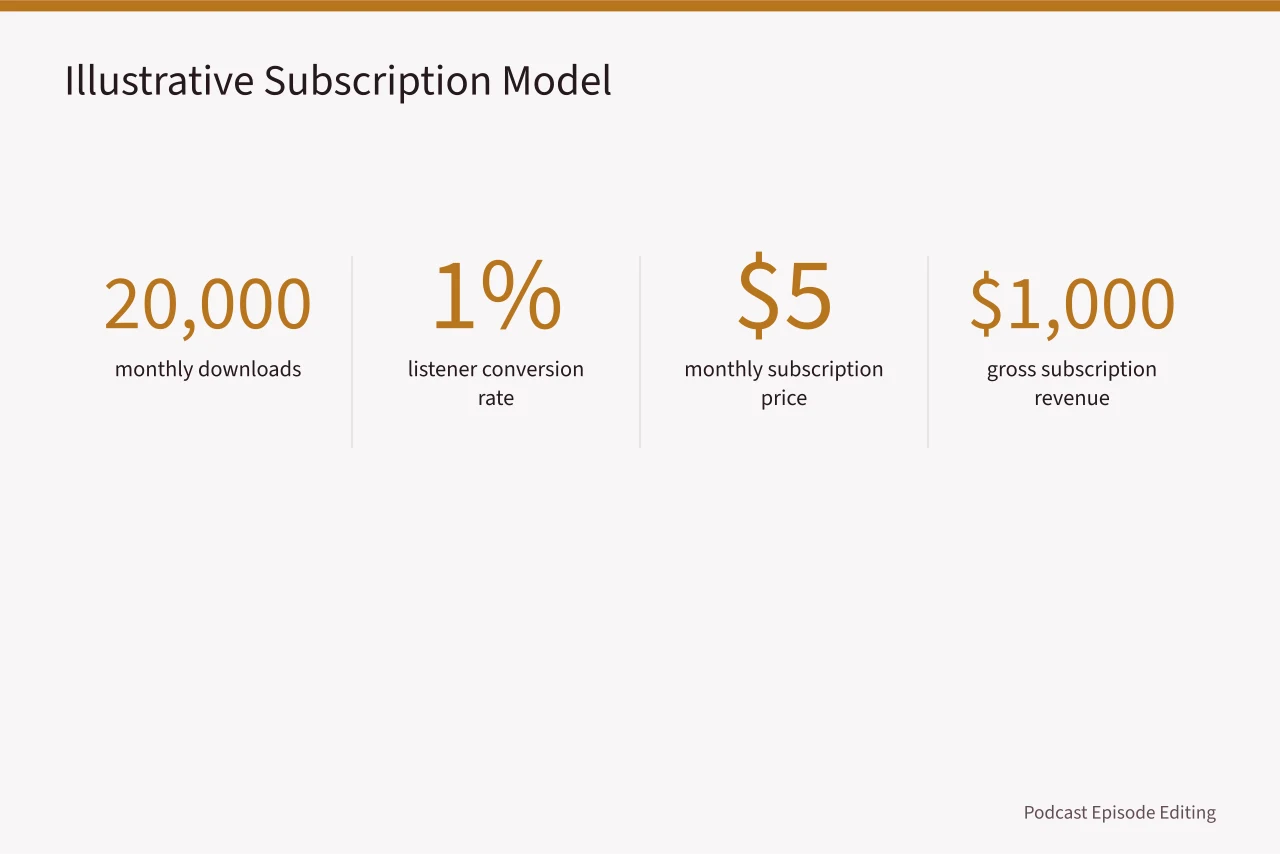
Let D be monthly downloads, C the share of listeners who convert to a paid subscription, and P the monthly subscription price. Apple's gross subscription revenue is D x C x P, and Apple keeps 0.30 of it in a subscriber's first year.
For ad revenue, let A be your monthly ad revenue before the platform's share and S the share Spotify or YouTube states in your terms. Your take is A x S.
Seattle is one example where local market conditions change the inputs, not the formulas. The region's streaming audio and tech employer base is deep, and the Seattle metro wage for audio and video technicians is published by occupation in the Occupational Employment and Wage Statistics tables.
Those published wages set a local floor for freelance editing and production, and more local listeners already pay for audio subscriptions, which raises C.
For ad money, the local CPM is the input that matters most: the rate a sponsor pays per thousand downloads. Host-read podcast CPMs typically run from the mid teens to the low forties in US dollars.
Seattle's metro household income sits above the US median, so local sponsors pay for an affluent audience. Use the rate your sponsor quotes, not a national average.
Illustrative figures, not local benchmarks: 20,000 downloads, 1 percent conversion, $5 monthly price. Gross subscription revenue is 20,000 x 0.01 x $5, or $1,000, and Apple keeps $300 in the first year. Your conversion rate and price are the ones that matter.
Paperwork, thresholds and cash-flow timing
All three platforms report US earnings to the IRS, but the forms and timelines differ enough to affect your quarterly estimates.
A sole proprietor can use a Social Security number, but an LLC or partnership needs an employer identification number from the IRS. Set that up before connecting a payout account, because mismatched names stall payments.
Plan cash flow around the slowest payer, not the fastest. YouTube is the most predictable. Apple lags. Spotify depends on your payout partner.
Keep every platform statement. Podcast income is reported on Schedule C, and platform 1099s do not always match your records once refunds, chargebacks, and fees are netted out. A CPA can reconcile the difference; the IRS sets the reporting rules, and your state revenue authority sets what else you owe.
Choosing a mix, and reading the numbers monthly
Most small shows should not run all three programs at once. The admin load is real, and each platform wants different formats.
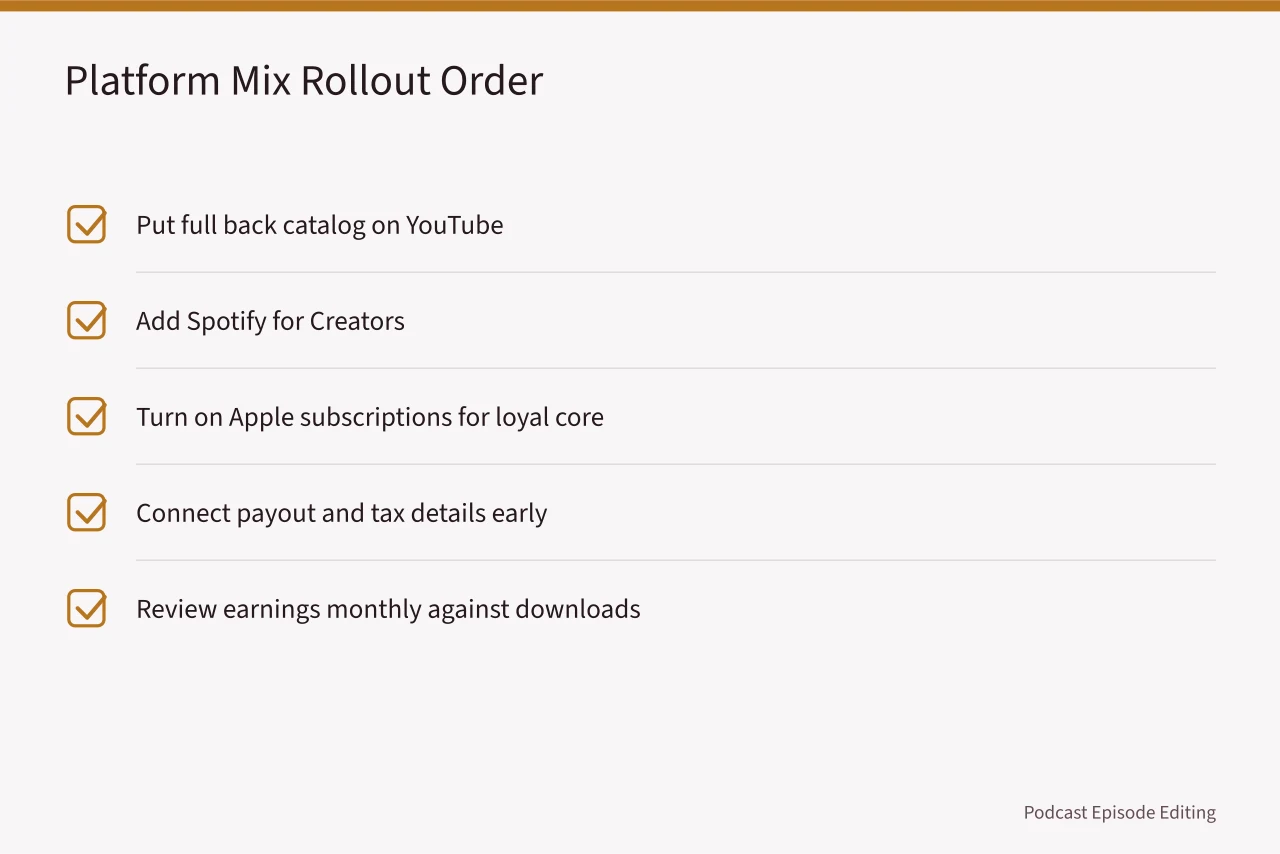
- Put the full back catalog on YouTube if discovery is the bottleneck. The $100 floor is reachable and search traffic compounds.
- Add Spotify for Creators so audio listeners generate ad and subscription revenue without extra work.
- Turn on Apple subscriptions only if a loyal core will pay, and remember the 30 percent first-year commission.
- Connect payout accounts and tax details before you cross a threshold, not after.
- Review earnings monthly against your own download and conversion numbers.
Track subscription conversion next to downloads so you are not guessing. Our podcast revenue metrics guide sets out which numbers to watch monthly, and the podcast platform fees breakdown shows how each host takes its cut before the platform does.
If you are still choosing where to host and distribute, that decision comes before payout optimization. Our podcast platform guide walks through the setup, and the tested roundup of podcast platforms covers the fee differences behind these choices. Our podcast analytics guide explains how to measure whether the mix is working.
Common questions
Does Spotify pay per download?
No. Spotify pays a share of ad revenue tied to ads served in your episodes, plus subscription revenue, and only shows admitted to the Partner Program receive ad money.
What is the YouTube payout threshold for podcasts?
YouTube pays once your combined balance reaches $100, after you meet the Partner Program's subscriber and watch-hour requirements. Payment runs monthly, usually around the 21st for the prior month.
How much does Apple keep from a subscription?
Apple keeps 30 percent of a subscriber's payment in that subscriber's first paid year and 15 percent in each year after. Reporting runs monthly with a lag before funds settle.
Do I need an EIN to receive platform payouts?
Not as a sole proprietor using your Social Security number, but an LLC or partnership needs an EIN from the IRS before connecting a payout account. Mismatched names stall payments.